Day 1: Off to Central Asia!
Flight from Germany to the Uzbek capital, Tashkent. Transfer to the hotel. Free time.
Day 2: Tashkent-Urgench/Khiva
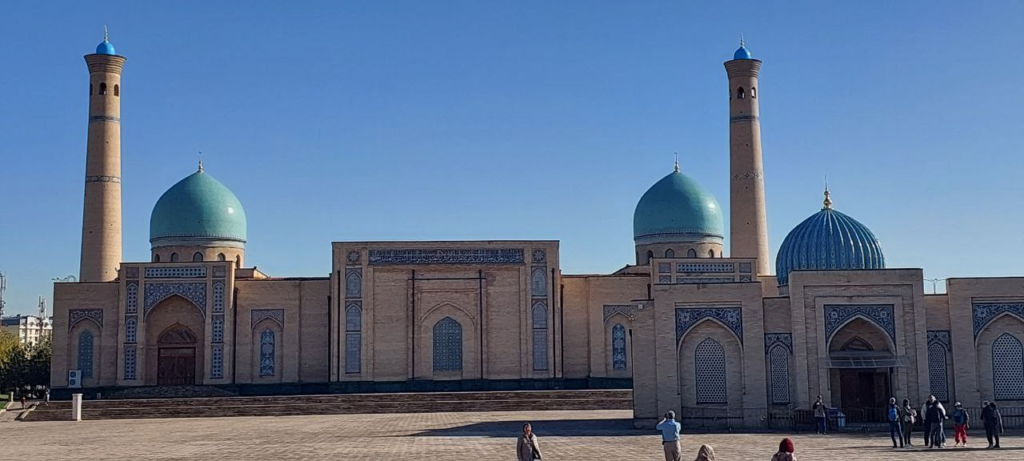
Tashkent – this city of one million inhabitants is modern, spacious, and very green. An earthquake almost completely destroyed it in 1966, and Soviet city planners redesigned it with wide boulevards and prefabricated buildings. Our first destination, the Hasrat Imam Complex, was the first mosque in what is now a largely Muslim Uzbekistan. The complex surrounding the tomb of the first Imam in Tashkent was rebuilt in 2007 with Saudi aid: The massive brick building with turquoise domes can accommodate 2,500 worshippers. We visit the intricately decorated Barak Khan Madrasa and plunge into the hustle and bustle of the Chorsu Bazaar with its abundant offerings of figs and nuts, vegetables, and spices. At the Museum of Applied Arts, we see handicrafts from many regions of the country: ceramics, knives, traditional costumes, and gold embroidery.
Flight to Urgench and transfer to the hotel in Khiva
Day 3: Through the oasis city of Khiva.
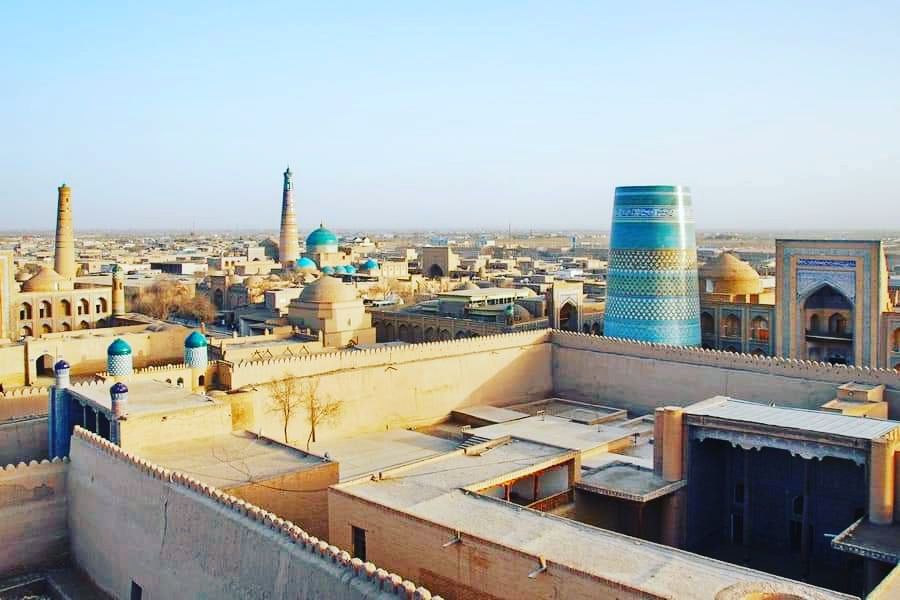
The Silk Road, which connected the Mediterranean with East Asia from 300 BC onwards, also ran through Khiva, transporting not only silk but also spices, incense, porcelain, wood, and rose oil to the West. Legend has it that caravans rested at a well dug by a son of Noah. The masterfully restored old town is still entirely surrounded by its city walls. We explore between mosques, madrasas, and mud houses with numerous ceramic workshops. Why is the famous Kalta Minor minaret, with its colorful glazed tile decoration, so short? A local specialty are the imaginative plant and star ornaments, like those found on the fortress’s summer mosque. From the battlements, we enjoy the panoramic view. In the Juma Mosque of the former palace, we are enchanted by 213 intricately carved columns, some of which are over 1,000 years old. One of the most important buildings in Islamic Central Asia is dedicated to a poet: the fantastically decorated Pahlavon Mahmud Mausoleum, with its turquoise-blue dome visible from afar, commemorates the 13th-century physician and poet. For dinner, we are hosted by a family and engage in conversation about everyday life in this surprisingly open Muslim country. In the Tash Hauli Palace, with its three courtyards, we admire tile decorations and intricate carvings
and hear about the former harem. We continue to the Alla Kuli Khan Madrasa, the caravanserai at the city’s eastern gate.
Day 4: From Khiva to Bukhara (450 km)
Today we travel 450 km along the Amu Darya and Oxus Rivers, and through the Kyzyl-Kum Desert to Bukhara. During the journey, you can be enchanted by one of the largest desert landscapes in Central Asia. We will make plenty of photo stops.
Day 5: Bukhara, the Noble
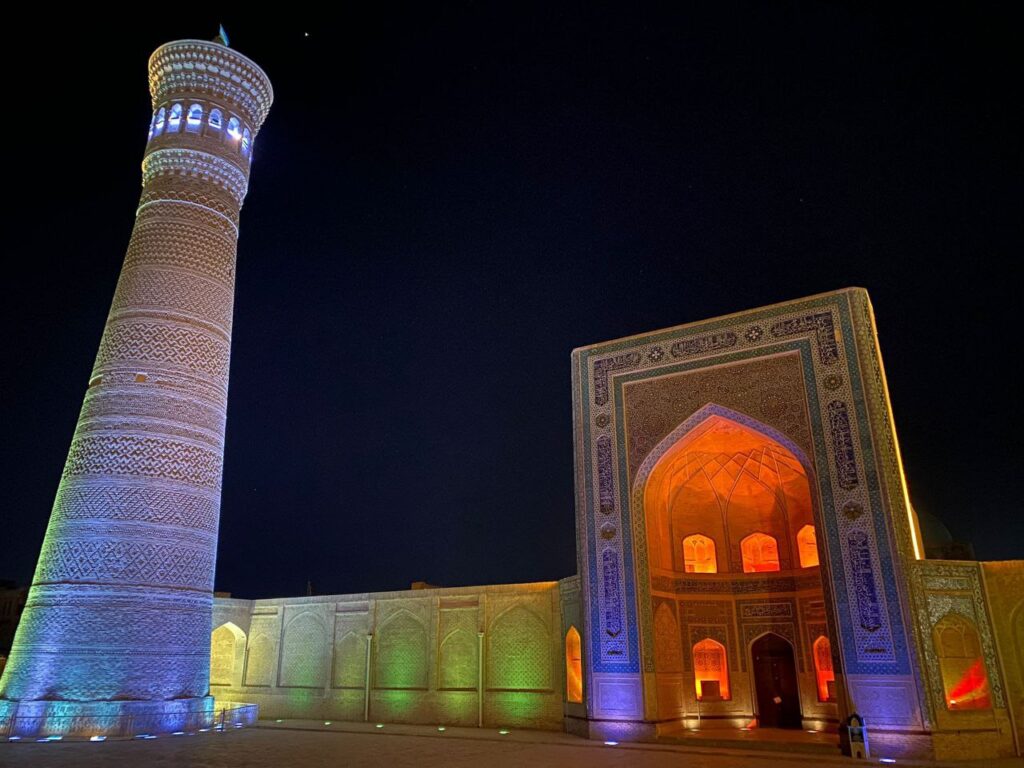
Bukhara – in this 2,500-year-old oasis city, we experience the full fascination of the Orient: mosques with luminous domes, Koranic schools, and caravanserais. The intact old town resembles an open-air stage, transporting us to the adventures of 1001 Nights. We visit the Samanid Mausoleum, arguably the oldest magnificent tomb in the Islamic-Oriental world. The ruler Ismail Ibn Ahmad presumably rests beneath the masterful dome from the 9th century. The Chashmai Ayyub Mausoleum was built where the prophet Job is said to have hewn a spring from the rock. The tour continues to the Ark Fortress, high on the mountain, and to the small Bola Xaus Mosque. The Labi Xaus complex is grouped around a large pool. A special attraction are the domed bazaars, bustling with activity: beneath the artisan vaults, you can hear the hammers of shoemakers and scissors makers, while the jewelers’ shops, perfume, fabric, and hat sellers overflow with wares.
Day 6: Bukhara-Nurata/Yurt Camp (230 km)
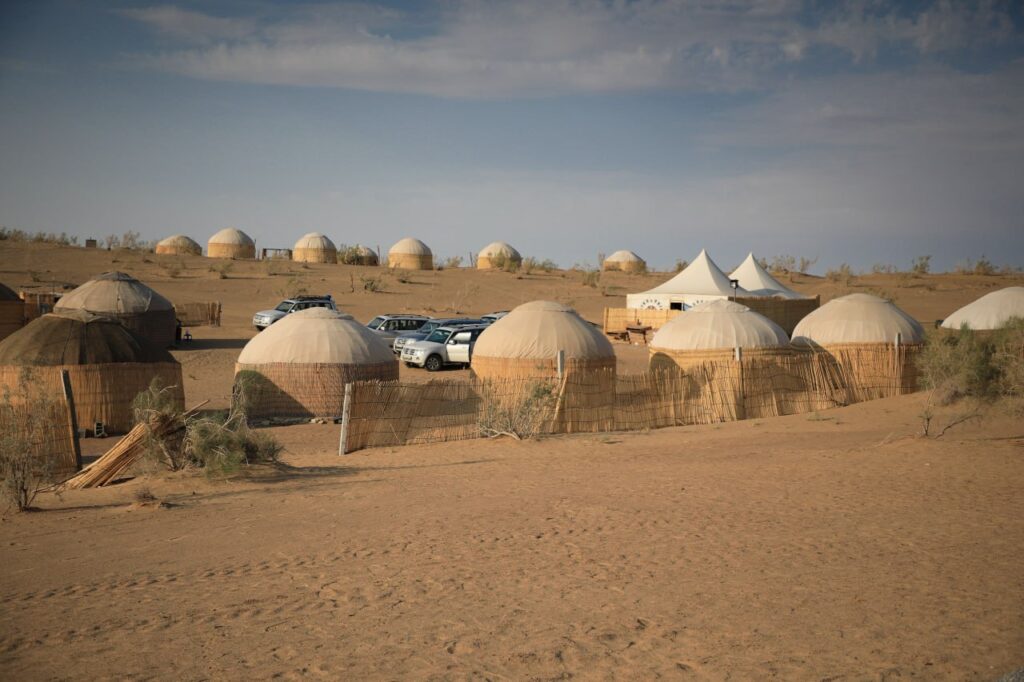
The Royal Road, the ancient connecting route to Samarkand, begins on the western outskirts of the city. During the heyday of the Silk Road, trade caravans traveled here, reaching Samarkand after a 6-7 day ride. About halfway there, in the middle of the desert, stands a monumental gate that seems to lead into nowhere. It is the last remnant of the Rabat-i-Malik caravanserai, and the ancient Silk Road ran right through it. Our route leads to Nurata. After lunch at a private house, we visit the fortress from the 4th/3rd century BC, a mosque from the 11th century, and the Chashma spring. We continue to the yurt camp. After dinner, enjoy typical Kazakh songs by a local folk singer around the campfire.
Day 7: Yurt Camp — Aidarkul Lake — Sentab Mountain Village (115 km)
After breakfast, you will drive to Aidarkul Lake. We will take a walk along the lake. We will continue to the mountain village of Sentab. Arrival and accommodation with a local family.
Day 8: Sentab Mountain Village — Samarkand (170 km)
We set off early to avoid the worst of the heat on our hike. The trail (2-3 hours, easy) leads through a wide valley, past scattered houses, ruins, and a mosque near an old fortress. On weekdays, we frequently encounter children on their way to school or farmers with their fully laden donkeys. In the afternoon, we will drive to Samarkand (approx. 220 km). Arrival in Samarkand and free time.
Day 9: Proud Samarkand
Samarkand – even under the ancient Persians, this was one of the most important trading centers on the Silk Road. Devastated by Genghis Khan in the 12th century, Amir Timur made the caravan oasis the capital of his vast Asian empire two centuries later. The historic buildings are beautifully arranged throughout this city, which has been shaped by the Soviet era. Even during his lifetime, the conqueror Amir Timur had the Gur-Amir Mausoleum built. The enormous melon-shaped dome gleams in dark blue and turquoise. Strange things are said to have happened here when Stalin had the tomb opened. Our guide recounts this. In the center lies Registan Square, considered by many to be the most beautiful in the Islamic world. The three madrasas date back to the 15th-century university. In the Bibi-Hanim Mosque, we hear the legend of Timur’s beautiful wife. The ruler, jealous of the architect, is said to have completed it himself in such megalomania that it collapsed.
Day 10: Samarkand — Tashkent (280 km by train)
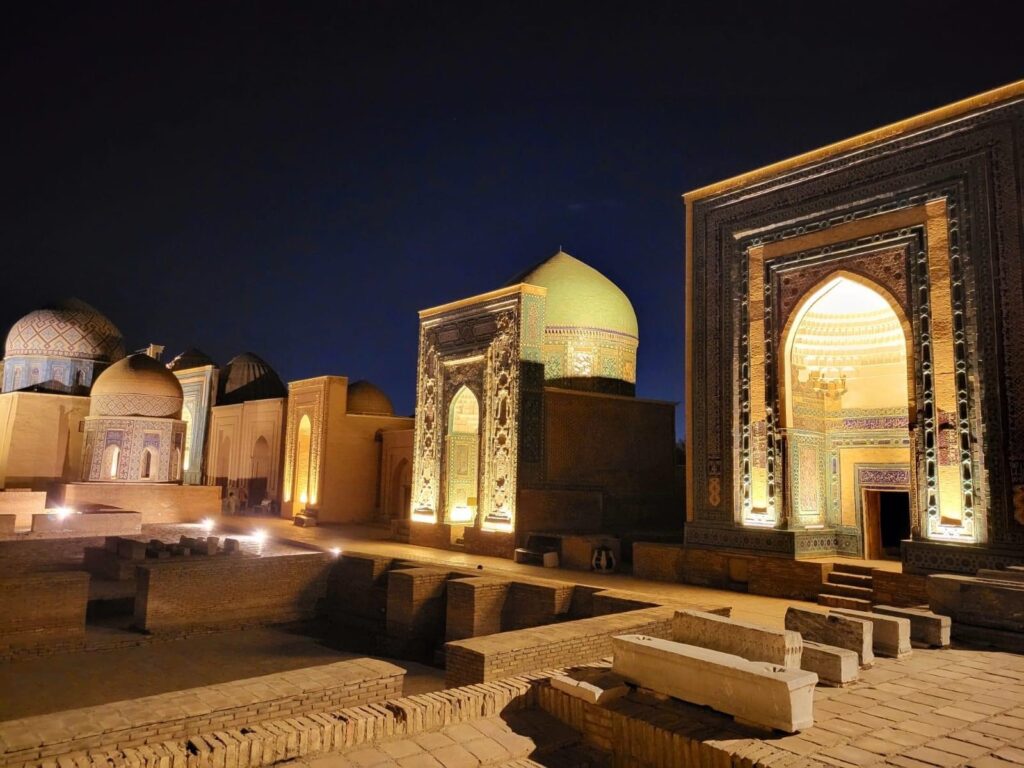
Samarkand — the excavations of ancient Marakanda and the Afrosiab Museum take us back to the origins of Samarkand. Just outside the city lies the astonishingly modern Ulugh Beg Observatory: Long before the invention of the telescope, the astronomer observed the celestial events with the naked eye, designed a star atlas, and measured the position of the Earth’s axis. Right next to the bustling bazaar, we visit the Shahi-Zinda necropolis, which dates back to Kusam ibn Abbas, a cousin of the Prophet Muhammad. In the late afternoon, we travel by train to Tashkent.
Day 11: Return
Tashkent — early morning drive to the airport and return flight to Germany.
Included services:
Overnight stays with breakfast in a room with bath or shower and toilet
All transfers and transportation during the tour in comfortable, air-conditioned vehicles
Train journey from Samarkand to Tashkent
Guided tour in German in Khiva, Bukhara, Samarkand, and Tashkent.
One dinner in Khiva with a local family and one lunch during the journey from Khiva to Bukhara.
Entrance fees for the monuments
Domestic flight from Tashkent to Urgench
Not included:
International flight
Lunch and dinner
Travel insurance
Hotels
| Location | Hotels |
| Khiva | Hotel Darvaza or hotel Grand Vizir |
| Bukhara | Hotel Komil Boutique or Hotel Emirald |
| Samarkand | Hotel Konstantin or Hotel Konstantin Plaza |
| Tashkent | Hotel Unique or Hotel MaxWell |