Day 1: Germany — Tashkent
Flight from Germany to Tashkent. Arrival in Tashkent, transfer to the hotel. Overnight at the hotel.
Day 2: Tashkent
Tashkent has a history spanning more than 2,200 years. Tchach (the city’s former name) was an important commercial and cultural center in Central Asia and welcomed the caravans of the Silk Road. Under the Khaybanid dynasty, large madrasas and mosques were built in the 16th century; this was the city’s golden age: the Hazrat Imam complex, including the madrasa of Barak Khan (16th century), the ancient Jami Mosque (Friday Mosque), which is still active today, and the mausoleum of Kaffal Chachi – the pilgrimage site with the tomb of a great philosopher, poet, and doctor of Islam who lived in the 10th century; and the Grand Bazaar, Tcharsu, very beautiful and very typical. The Tashkent Metro, the first in Central Asia, is unique in that each of its stations was designed by the country’s greatest artists around a specific theme: cotton, the Uzbek poet Alikher Navoi, etc. Panoramic tour: Amir Temur Square, Independence Square, Theater Square, etc. Overnight at the hotel.
Day 3: Tashkent – Khujand (Tajikistan) (165 km)
Breakfast at the hotel. Transfer to the Tajik-Uzbek border. Customs formalities. Transfer to Khujand. Arrival and sightseeing in Khujand. Khujand is located not far from the Fergana Valley on the Syr Darya River. It is another ancient city with a history dating back to Cyrus the Great of Persia and Alexander the Great. Today, it is the second largest city in Tajikistan and home to the largest market in Tajikistan – the Panjshanbe Bazaar. The city tour of Khujand includes the bazaar and the adjacent Maslihaddin Mosque, the Khujand Historical Museum, and the Arbob Palace. In the evening, we will take a walk in Kmaoli Khujand Park and see the Lenin Statue. Dinner. Overnight at the hotel.
Day 4: Khujand — Istaravshan — Penjikent (260 km)
From Khujand, we first travel to Istarafshan and finally to Penjikent. Istarafshan was founded in the 6th century BC by Cyrus the Great and recently celebrated its 2,500th anniversary. The Timurids of the 14th century then called themselves Istaravshan Ura-Tube, and the city’s artisans were highly respected in Central Asia. Today, Istarafshan is known in Tajikistan for its blacksmiths, who produce, among other things, high-quality knives. We will visit the blacksmith workshops near the market entrance. Continue to Penjikent. The road from Istaravshan to Penjikent is very scenic and crosses the Shakhriston Pass. Arrival in Penjikent. Dinner. Overnight at the hotel.
Day 5: Penjikent – Seven Lakes – Penjikent
Breakfast and visit to the remains of ancient Sarazm (5,500 years of history). Archaeological excavations have uncovered traces of the ancient irrigation system. In the fourth millennium BC, Sarazm became a major metallurgical center, processing gold, silver, copper, and other metals.
About half an hour from Penjikent, we drive towards Dushanbe, turn right, and follow a mountain road that leads us through the Shing Gorge with its famous Seven Pearls of Tajikistan – seven mountain lakes, each with its own unique color, microclimate, and flora. We will certainly make a photo stop at each of the lakes. The roads are very poor and steep, but we’re lucky to have experienced drivers. After a picnic lunch, we continue to the sixth lake, taking a short walk in the village of Podrud. From the sixth lake, we hike in less than an hour to the seventh and final lake, Hazorchashma. We’ll rest, enjoy the scenery, and meet some shepherds who stay there with their sheep during the summer months. After a short while, we hike down to the car at the sixth lake and return to Penjikent. Overnight at the hotel.
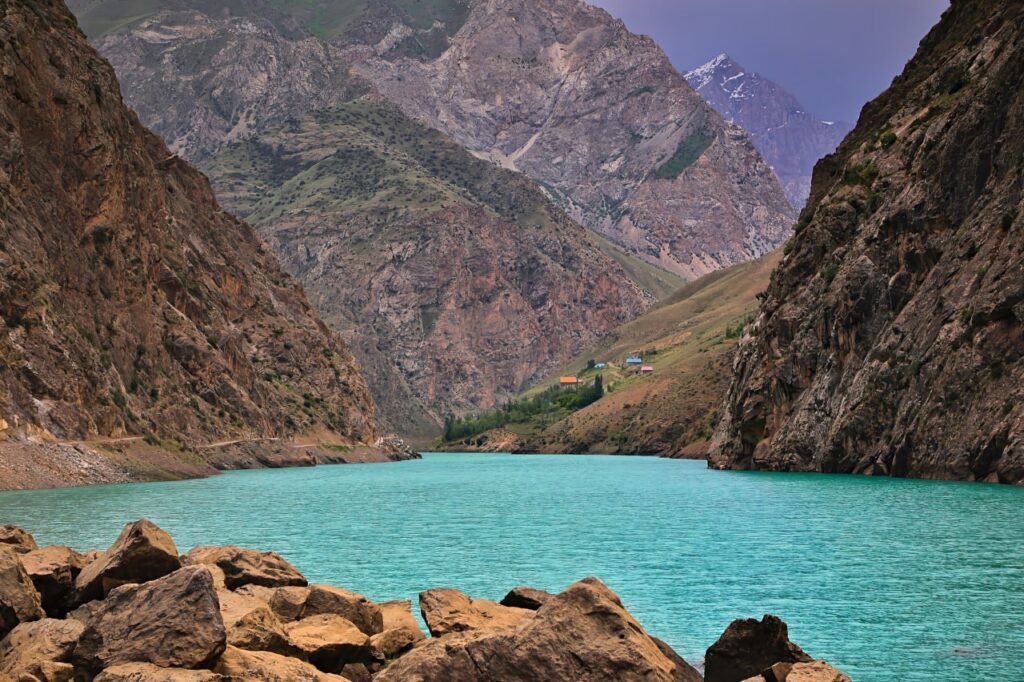
Day 6: Penjikent – Dushanbe (235 km)
After a leisurely breakfast, we drive 235 km towards the Tajik capital, Dushanbe. Upon arrival, we begin our city tour of Dushanbe with a visit to the National Archaeological Museum of Tajikistan. Our next stop is the Navruz Palace. This building was originally intended to be the largest teahouse in the world. During construction, which involved hundreds of artisans from across the country, the interior became so impressive that it was decided to convert it into a palace instead of a teahouse. Today, most of the rooms are used exclusively for official government meetings with guests from abroad or for international conferences. We then visit the statue of Ismail Samani. Dinner. Overnight at the hotel.
Day 7: Dushanbe – Shahrisabz (Uzbekistan)
Early morning transfer to the Uzbek-Tajik border. Customs and passport control on both sides, border crossing, and onward journey to Shahrisabz. Arrival in Shahrisabz. Dinner. Overnight at the hotel.
Day 8: Shahrisabz – Samarkand (170 km)
Shahrisabz, known in ancient times as Kesh, was probably founded in the 3rd century BC. Timur, the later ruler of Transoxiana, was born here in 1336. He planned to develop Kesh, instead of Samarkand, into the capital of his empire and commissioned buildings of some monumental dimensions.
Today in Shahrisabz, we visit the Dorut Tilovat complex, including the Kok Gumbaz Mosque (1435). The inscription in the portal testifies that it was built by Ulugbek in the name of his father, Shakhrukh. We then visit the Darus-Saodat complex, including the Jahangir Mausoleum (1379/80). Timur’s son Jahangir fell from his horse at the age of 12 and died. In the afternoon, we continue to Samarkand. Arrival in Samarkand. Dinner with an Uzbek family. Overnight at the hotel.
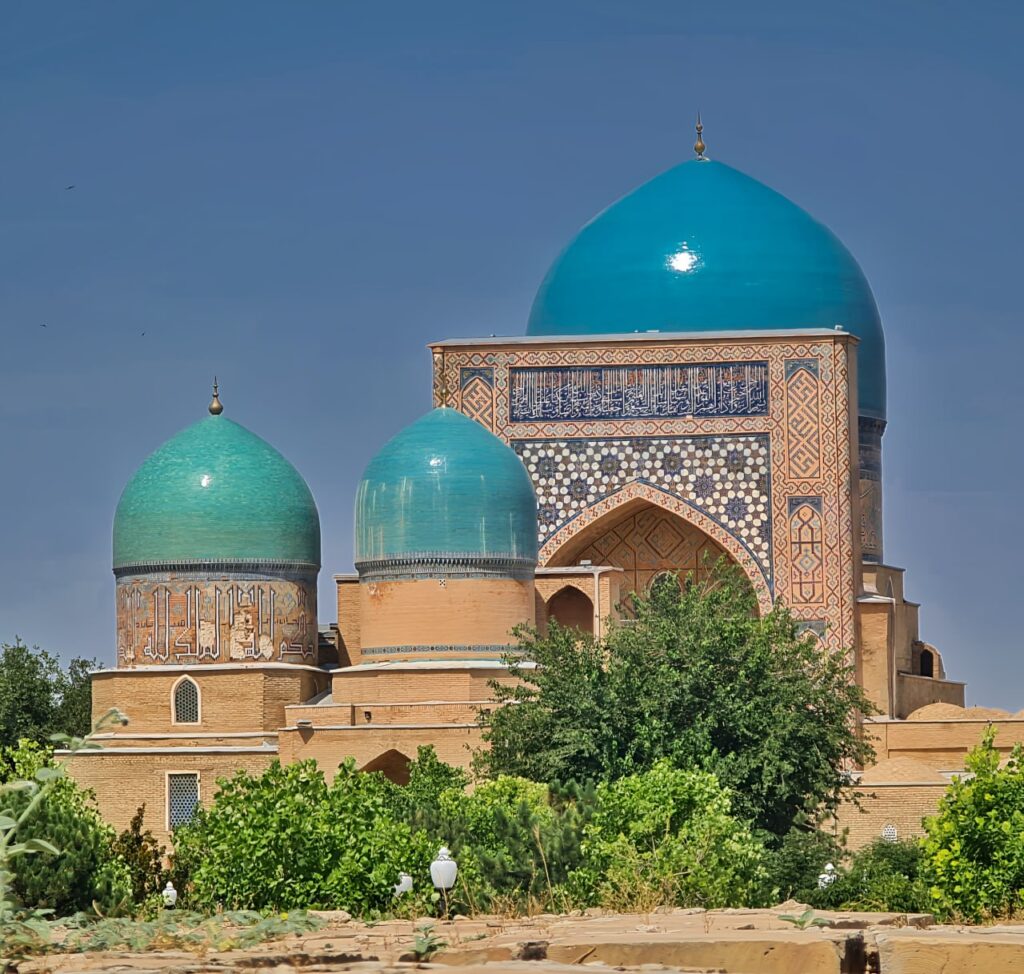
Day 9: Samarkand.
Samarkand is the second-largest city in Uzbekistan, the center of the Samarkand region. Today, Samarkand is primarily known for its many mosques and mausoleums. Currently, the city has a population of approximately 520,000, mainly Tajiks, Uzbeks, Russians, Jews, and Iranians.
Sightseeing in Samarkand
The Gur-Emir Mausoleum (15th century), translated as «Tomb of the Lord,» was built between the late 14th and mid-15th centuries as a burial site of the Timurids. Registan Square is the most famous symbol of Uzbekistan. The three Koranic schools – Ulugbek Madrasa (15th century), Tilla Kori Madrasa (17th century), and Sher Dor Madrasa (17th century) – still characterize the Registan today. The Bibi-Khanym Mosque was built by Tamerlane in the 15th century as the largest Friday mosque in Central Asia for his favorite wife.
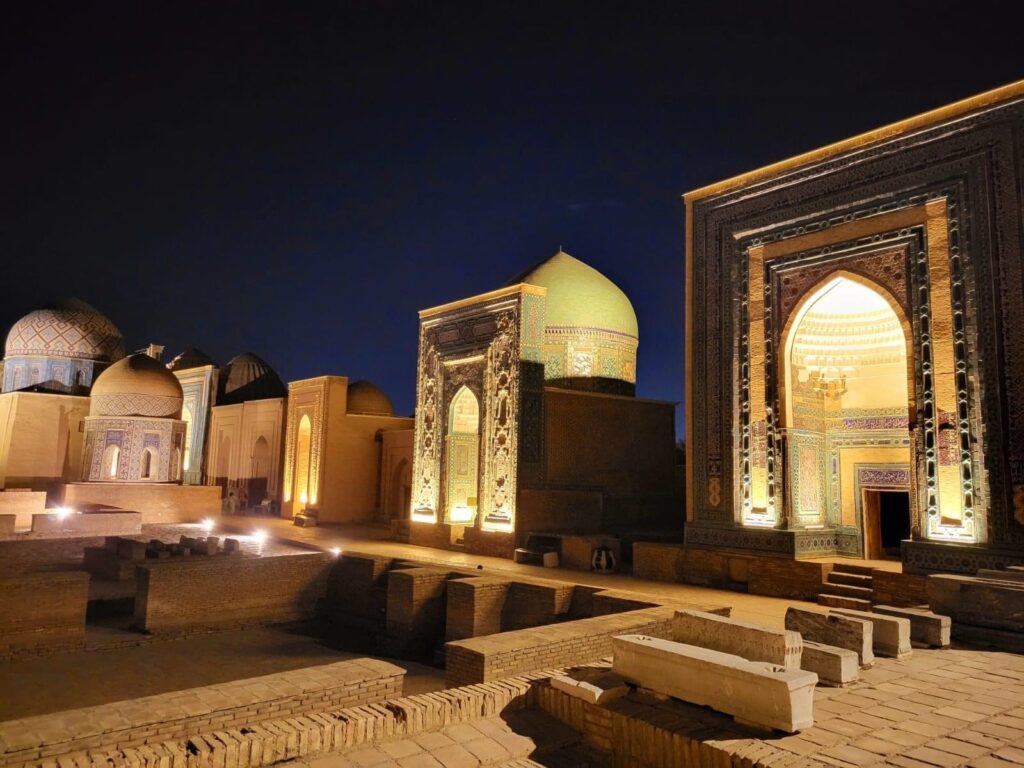
Day 10: Samarkand – Bukhara (270 km)
The Royal Road, the ancient connecting route to Bukhara, begins on the western outskirts of the city. During the heyday of the Silk Road, trade caravans traveled here, reaching Bukhara after a 6-7 day ride. About halfway there, in the middle of the desert, stands a monumental gate that seems to lead into nowhere. It is the last remnant of a Rabat-i-Malik caravanserai, and the ancient Silk Road ran right through it. Near the caravanserai lies Sardoba, a water cistern that once served as a refueling station for the caravans. Continue to Bukhara. Dinner. Overnight at the hotel.
Day 11: Bukhara
Bukhara – in this 2,500-year-old oasis city, we experience the full fascination of the Orient: mosques with luminous domes, Koranic schools, and caravanserais. The intact old town resembles an open-air stage, transporting us to the adventures of 1001 Nights. We visit the Samanid Mausoleum, arguably the oldest magnificent tomb
in the Islamic-Oriental world. The ruler Ismail Ibn Ahmad presumably rests beneath the masterful 9th-century dome. The Chashmai Ayyub Mausoleum was built where the prophet Job is said to have carved a spring from the rock. We continue to the Ark Fortress high on the mountain, the small Bola Xaus Mosque, and the Kalon Mosque. The Labi Xaus complex is grouped around a large pool. A special attraction are the domed bazaars, bustling with activity: beneath the artisan vaults, you can hear the hammers of shoemakers and scissors makers, while the jewelers’ shops, perfume, fabric, and hat sellers overflow with wares.
Day 12: Bukhara – Khiva (450 km)
After breakfast, we drive along the ancient Silk Road through the Kyzylkum Desert, one of the largest desert landscapes in Central Asia. Along the way, we take a break near the Amu Darya River, which once flowed into the Aral Sea. At the edge of the desert, we see vast cotton and vegetable fields.
Our destination is Khiva, once one of the richest trading cities on the Silk Road (UNESCO World Heritage Site).
Day 13: Khiva
Khiva – the capital of the Turkic world. Khiva is the most beautiful oasis city in Uzbekistan, with ancient museums, minarets, and unique mud buildings. At the 11th session of the Organization of Islamic Cooperation (OIC) in Baku, Khiva was declared the tourist capital of the Islamic world in 2024.
Sightseeing in Khiva: The Juma Mosque (1788/89) has a tall minaret topped with a narrow belt of blue glaze. Originally, there were 212 pillars supporting the ceiling. The Pakhlavon Mahmud Mausoleum. Pakhlavon Mahmud (1247-1325), as his surname suggests, was a furrier. A domed mausoleum was built over his grave. The Islam Khodja Minaret and Madrasa, both built at the beginning of the 20th century, is the last major project to be built in the Central Asian khanates. The Kalta Minor and the Madrasa of Muhammad Amin Khan, both built in the mid-19th century. Further sightseeing.
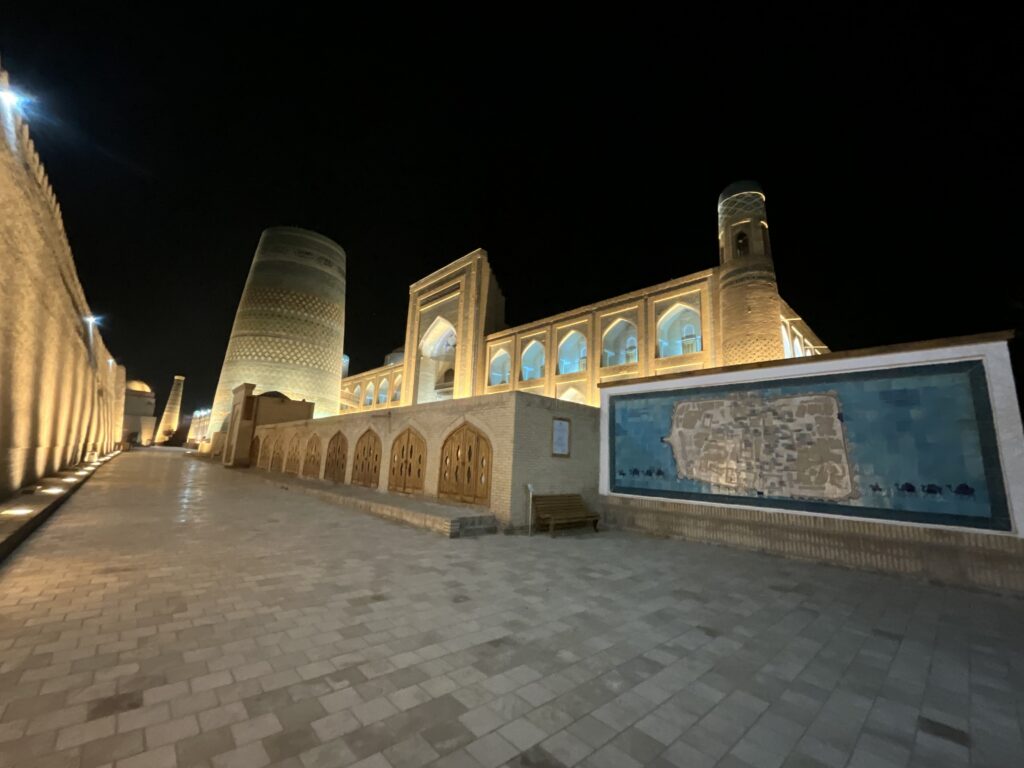
Day 14: Khiva
Further sightseeing in Khiva: Kohna Ark Citadel, the Tash Hauli Palace, the Allakuli Khan Madrasa and Caravanserai, and the
Nurullabay Palace. Free time in the afternoon.
Day 15: Khiva – Dashoguz – Konya Urgench – Darwaza (Turkmenistan).
Transfer to the Uzbek-Turkmen border. Arrival at the Uzbek-Turkmen border from Dashoguz. Transfer to Konya Urgench. Visit Konya Urgench: Turabeg Khan Mausoleum, Kutlug Temur Minaret (62 meters), Sultan Tekesh Mausoleum, II Arslan Mausoleums, and Kirkmolla Mound (Mound of the Forty Mullahs). Continue to Darwaza (Gaz Crater), the «famous Gate of Hell.» Upon arrival in Darwaza, visit the gas crater. Dinner (picnic barbecue) and overnight in a tent near the gas crater.
Day 16: Darwaza – Ashgabat (250 km)
After breakfast, continue to Ashgabat through the Karakum Desert, stopping in the villages. Arrive in Ashgabat and check in at the hotel. Visit the Turkmen Horse Monument, the Arch of Neutrality, the Independence Monument, and the Ertogul Gazy Mosque. Stay overnight at the hotel.
Day 17: Ashgabat – Merv
Breakfast at the hotel. Transfer to the airport for the flight from Ashgabat to Merv. Arrive in Merv and continue to Merv (35 km). Visit ancient Merv, the «Pearl of the Orient,» or ancient Margiana. Margouch, the capital of the Seljuk Turks during the time of Alexander the Great, is one of the oldest and best-preserved oasis cities on the ancient Silk Road. Visit the koshks (fortresses) of Kyz Qala, the Qala Askhab complex, the Giaur Qala fortress, the Sultan Sanjar Mausoleum, the largest structure in medieval Central Asia, and Erk Qala, a 6th-century Achaemenid city with its city walls. Overnight at the hotel in Merv.
Day 18: Merv – Bukhara (Uzbekistan)
Transfer to the Turkmen-Uzbek border. Continue to Bukhara. Arrival and accommodation at the hotel.
Day 19: Bukhara – Tashkent (train) (600 km)
Today we have the entire morning at leisure in Bukhara, and in the afternoon we travel by express train «Afrosiyob» to Tashkent.
Day 20: Tashkent – Germany
Transfer to Tashkent International Airport and flight to
Germany.
Price in euros per person:
€2,945 (5 to 9 guests)
€2,725 (10 to 16 guests)
Single room supplement: €390
Services included
Uzbekistan
Hotel accommodation with breakfast
Tour guide
Transportation
Train from Bukhara to Tashkent
All entrance fees
Dinner
Turkmenistan
Hotel accommodation with breakfast
Letter of invitation
Registration in the city of Ashgabat
Dinner
Barbecue dinner and picnic breakfast at Darwaza.
Tour guide
Transportation
Domestic flight Ashgabat — Mary
Tourist tax
Tajikistan
Hotel accommodation with breakfast
Transportation
Dinner.
Tour guide
All entrance fees
Visa support for Tajikistan
Not included in the price.
International Flight Tickets
Lunch
Alcoholic Beverages
Travel Insurance
Gratuities
Visa fee for Turkmenistan (currently, it costs $70 to $100 depending on how many days you stay in the country). PZR test for Turkmenistan (currently, $33)
Hotels
Uzbekistan:
Tashkent – Hotel Unique, MaxWell Hotel & Spa, or similar
Shahrizabz – Kesh Palace
Khiva – Hotel Darvaza, Hotel Grand Vizir, or similar
Bukhara – Hotel Al-Malik, Hotel Komil Boutique, or similar
Samarkand – Hotel Malika Prime, Hotel Konstantin Plaza, or similar
. Turkmenistan
Sport Hotel 4* — 1 night
Mary Hotel 4* — 1 night
Tent stay (yurt overnight stay) in Darwaza.
Tajikistan
Dushanbe — Serena or Hilton Dushanbe Hotel 5*
Pendjikent — Pandjikent Plaza or Rudaki 3*
Khujand — Khudjand Deluxe or Parliament 4*.